
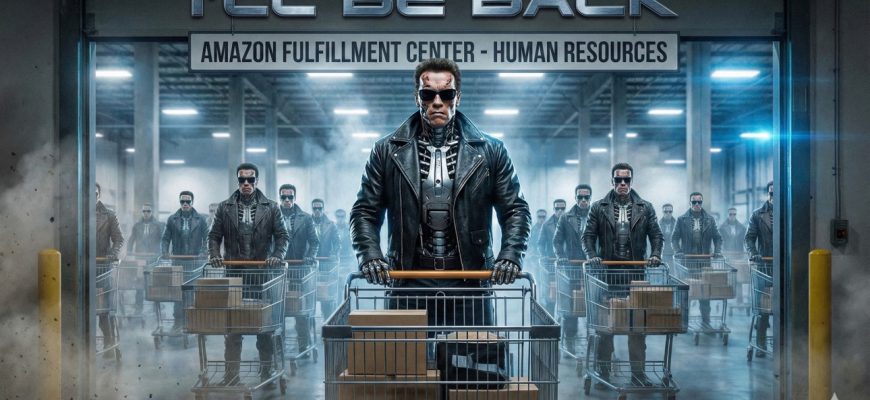
The situation on the job market right now resembles waiting for a tsunami on a beach where half the vacationers don’t believe the wave is coming, and the other half are feverishly buying inflatable boats. We are on the verge of the greatest workforce shake-up since the Industrial Revolution, only this time it will happen in five years, not a hundred.
We used to fear that Terminator-style robots would come and destroy us. The reality turned out to be more prosaic: they came to make us economically unviable. While Silicon Valley celebrates yet another breakthrough, the rest of the world is staring at its own termination notice, written in perfect GPT prompt language.
The labor market has frozen in anticipation. This blow will not be delivered with a sledgehammer, but with a scalpel—precisely, ruthlessly, and in the name of sacred Efficiency.
- The Canary in Bezos’ Coal Mine
- The Efficiency Pincers: Everyone Is Under Attack
- Flank 1: Monotonous Labor (Blue Collar)
- Flank 2: The Intellectual Trap (White Collar)
- Islands of Safety: Whom ChatGPT Will Not Replace (Yet)
- The Golden Age of Big Pharma
- Two Paths: Cyber-Feudalism or Heaven on Earth
- Verdict: Where Are We Going?
The Canary in Bezos’ Coal Mine
An alarm signal sounded from where optimization has long been a religion. Amazon workers—people whose productivity is measured in seconds—wrote an open letter to management. Their fear: the pace of AI integration into logistics will kill their jobs faster than they can retrain.
This is the “first swallow” of a global crisis. Amazon has always been a proving ground for the future. Where ten people were previously required for sorting, now one operator and a pack of robot manipulators are needed.
The Efficiency Pincers: Everyone Is Under Attack
The most dangerous illusion of today is to think: “This won’t touch me, I’m a ‘white collar’ worker, I am the creative class.”
The AI job loss phenomenon is attacking from two flanks simultaneously:
Flank 1: Monotonous Labor (Blue Collar)
Here everything is obvious. Warehouse workers, call center operators, truckers, cashiers. Any work described by a clear algorithm will be automated in the next 2-3 years. It is not a question of “if,” but “when the depreciation of a robot becomes cheaper than a human salary.”
Flank 2: The Intellectual Trap (White Collar)
This is where the real drama unfolds. We thought AI would replace mediocrities. No, it will make the talented too efficient.
Imagine a legal department of ten people. AI won’t replace all of them. But it will allow the two smartest employees to do the volume of work that all ten previously did.
- What happens to the other eight? They will be fired. Not because they are bad, but because they are redundant.
This mirrors exactly what we are seeing in the film industry, where studios are replacing junior artists and writers with algorithms. (We analyzed this trend in detail in our article: How AI Is Rewriting Hollywood’s Future Script).
Islands of Safety: Whom ChatGPT Will Not Replace (Yet)
In this raging ocean, some professions remain “arks.” Their common feature is the need for complex physical interaction or profound emotional empathy:
- Dentists and Surgeons: The price of a mistake is too high, and human anatomy is too unique for current robots.
- Teachers (Elementary): AI can plan a lesson, but it cannot comfort a crying child or teach empathy.
- Skilled Trades (Plumbers, Electricians): Robots fail when faced with the chaos of an old house with crooked walls.
- Psychotherapists: Synthetic sympathy does not work yet. A human needs a human to survive grief.
The Golden Age of Big Pharma
But even those who remain will live in stress. The fear of becoming obsolete is breaking records.
We are entering an era of global anxiety. If anyone pops champagne, it’s the manufacturers of antidepressants. Pharmaceutical giants will become the main beneficiaries of the AI revolution.
Demand for psychologist services and mental health support will skyrocket. (Ironically, even this field is being automated, as we explored in Emotional Intimacy in AI Therapy).
Two Paths: Cyber-Feudalism or Heaven on Earth
Where will the job market go in the next 5 years?
Scenario 1: Cyber-Feudalism (Negative)
All benefits settle in the pockets of technology owners. The middle class is washed away. Society polarizes into a tiny elite of “algorithm owners” and a huge mass of people competing for low-paid physical work. Result: Rising social tension and 21st-century Luddite riots.
Scenario 2: Three-Day Utopia (Positive)
Governments introduce taxes on robots. Money goes to Universal Basic Income (UBI). People work 3 days a week because their efficiency has grown. Work becomes a means of self-realization, not survival.
Verdict: Where Are We Going?
Chief, if you expect optimism, I will disappoint you. The history of capitalism teaches us that capital never voluntarily shares profit.
My forecast: in the next 3-5 years, we will follow the negative scenario.
We will see mass layoffs and wild competition. And only when social pressure threatens the system itself will governments begin to introduce UBI. But until that moment, buckle your seatbelts. The turbulence zone is just beginning.


